What is Sparkle?
Sparkle is an opinionated Mac app that helps you build real software by using best-in-class tooling like Git and Claude Code in modern ways. It's built to be voice-first (3× faster than typing!… although you can still type if you're stubborn) and wraps the terminal in AI-enhanced features that let you focus on turning ideas into output.
A key part of Sparkle is something that the 1980's terminal has never had: a "thinking" layer powered by Chief, and a "planning" layer powered by Steve Yegge's beads and Jesse Vincent's superpowers OSS projects, all wrapped into one.
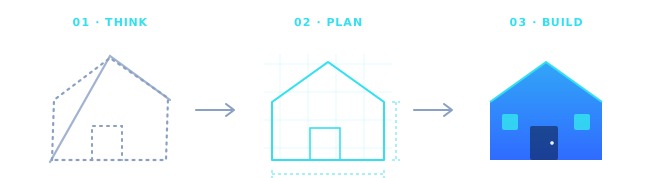
- Think: Ideate with Chief's AI thought partners in the room to interview and challenge your assumptions, creating well-thought-out, high-fidelity specs (aka PRDs) of what you want to build.
- Plan: Sparkle automatically breaks your PRD down into a prioritized list of tasks for the AI agents to work from.
- Build: You'll have full control over the orchestrator agents that spin up worker agents (all in Claude Code) to turn your idea into working software.
Welcome, Novice! Get ready to re-invent yourself as a builder, not just talker.
Take a breath. You're in the right place.
You don't think of yourself as a "builder." Maybe you've watched other people conjure software out of thin air and assumed there was a secret club you weren't invited to. There isn't. Sparkle is the tool that lets you walk in.
Here's the whole idea: instead of typing cryptic commands into a scary black window, you describe what you want, like texting a brilliant friend who builds the thing for you. Under the hood, a real AI coding tool called Claude Code does the work. Sparkle is the friendly, modern face on top of it, with buttons, panels, and even your voice ("Hey Sparkle…").
We'll define every scary word as it comes up (see the dotted underlines? hover them). Nobody is born knowing this stuff.
Everybody in this country should learn how to program a computer… because it teaches you how to think.
Welcome Overconfident Vibe Coder! Ready to show those "real engineers" what the future looks like?
You've done some vibe coding. You've also watched an AI confidently break your project and then had no idea how to put it back together.
Sparkle is built for exactly that gap. It gives the AI a real place to work (your actual project, in real git) and gives you the guardrails: see every change before it's permanent, run several agents at once without them trampling each other, and recover cleanly when something goes sideways. Less "pray and refresh," more "ship and review."
It's still Claude Code doing the building. Sparkle just makes it fast, parallel, and recoverable.
Simplicity is prerequisite for reliability.
Welcome Grizzled Veteran! Ready to re-invent yourself to stay ahead of those noobs wrecking your codebase?
Yes, it's another AI coding wrapper. Hold the eye-roll for two minutes.
Sparkle runs the real Claude Code (the same engine you'd drive from your shell) and adds the things that actually matter at scale: every agent gets its own worktree and branch, so you can fan out N agents in parallel with zero cross-contamination; a risk-tiered approval gate so nothing dangerous runs without your sign-off; highlight-any-line terminal actions; voice and screenshot input when you want them. Your code stays on your machine, in real git, with real commits. Not a sandbox. The client is MIT-licensed, so you can read every line.
It is not magic. It won't make a bad spec good. But it removes a stack of 1980s-era friction, and you can keep your terminal open the whole time.
There is no single development, in either technology or management technique, which by itself promises even one order-of-magnitude improvement within a decade in productivity, in reliability, in simplicity.
"No terminal required"? Let's be honest.
The 1980s terminal hasn't really changed since 1987: same black box, same blinking cursor, same total indifference to how humans actually think. Sparkle's pitch isn't that the terminal disappears. It's that you live above it. The Sparkle Composer is a modern layer that sits on top of the terminal, so the terminal is always right there underneath you. You are working above it instead of inside it, and you can drop down into it any time you want.
A terminal is the text-only window you've seen in movies where someone types fast and green text scrolls by. It's powerful, but it assumes you already know the magic words and punishes a single typo. Sparkle turns those magic words into buttons and plain-English requests, so you almost never open it.
New to all this? Here's a gentle, no-experience-needed primer on the command line, and a friendly intro to what Claude Code is.
You can muddle through a terminal with enough prompting, but you lose time to syntax you half-remember and errors you can't read. Sparkle keeps the power (a real terminal is one click away) and removes the friction: highlight any line for instant Explain / Fix / Run actions instead of googling the error.
The terminal is your safe place. Keep it. Sparkle doesn't hide it; it augments it. Highlight a line for ten contextual actions, drive it by voice when your hands are busy, drop in a screenshot when words are slower than a picture. If you want the raw shell, it's right there. Reference, if you care: the Claude Code docs.
How it's different from Claude Code in a terminal
Claude Code on its own lives entirely inside that scary text window. Same engine, but you'd be typing commands and reading walls of text. Sparkle gives you the same brain with a real interface: it shows you your projects, what each helper is doing, and exactly what changed, all visually, so you're never guessing.
Raw Claude Code is one agent, one conversation, in one terminal. Sparkle gives you parallel agents (each isolated so they can't break each other), a visual diff of every change before you keep it, and one-click pull requests when you're ready to make it official. The difference shows up the moment you're juggling more than one thing.
Same engine, different surface. On top of Claude Code, Sparkle adds project management, parallel worktree-isolated agents, the Sparkle Composer (a real editor instead of raw stdin), vision input, voice, and risk-tiered approvals. If you want the canonical mental model for the git side of this, Pro Git is still the reference.