What is Vibe Coding?
Let's get the obvious objection out of the way: "vibe coding" is, as Dario Amodei wrote in a foreword to the book bearing that name, a jokey term that can make the whole enterprise seem unserious or frivolous. It sounds like something you'd do on a beanbag chair at 2am (which you very well may end up doing). The name is almost a dare to roll your eyes.
Don't. Behind the silly name is one of the most serious shifts in how software gets built since the move from punch cards to keyboards. The term was coined by Andrej Karpathy as a half-joke about building by describing what you want instead of hand-typing every line. But the serious version of the idea, the one that actually matters, is laid out in Steve Yegge and Gene Kim's 2025 book Vibe Coding: Building Production-Grade Software with GenAI, Chat, Agents, and Beyond. That's where the joke grows up.
The serious shift behind the silly name
Yegge and Kim argue that the developer's job is changing at its core. Their thesis, in short: intent and flow now matter more than syntax. You stop laboring over the exact characters and start describing what you want in plain language, while AI materializes the implementation. Yegge calls the conversational version of this "chat-oriented programming" (CHOP); the book's later chapters push it further, to the point of running something like ten agents at once. The role shifts from line-by-line coder to something closer to an orchestrator and strategic guide: you direct, review, and integrate rather than type every keystroke.
Gene Kim, who spent a career studying flow and feedback in software delivery (The Phoenix Project, The DevOps Handbook), brings the lens that makes this more than a party trick: this is about flow at a new scale. And both authors are blunt that it is not a license to be sloppy. The book's recurring warning is that vibe coding done with reckless abandon, ignoring discipline, leads straight to chaos. The leverage is real, but so is the need for judgment.
Yes, you. Come in.
If "orchestrator," "agents," and "syntax" already sound like a members-only club you were never handed a card to, read this slowly: the door just opened, and you are the person it opened for. Not the engineers. You.
For decades, building software meant memorizing exact magic words and typing them flawlessly into a terminal. One wrong character and nothing worked. That wall is why you learned to say "I'm not technical" and hand your ideas to someone who was. Vibe coding takes that wall down. You describe what you want in plain English, and an AI coding tool called Claude Code does the careful typing for you.
So look at the one skill that matters now: knowing what you want and being able to tell whether you got it. You already have that. You have always had that. The thing that was missing was never the idea or the taste. It was the years of cryptic practice standing between you and the build, and that part just got handed to a machine. The gate is gone right as you walk up to it. You are not late. You are early, and you are exactly who this was built for.
You already feel the map redrawing
You've felt it: an AI built in twenty minutes something that used to eat your whole weekend. That wasn't a fluke or a cheat. It was the first tremor of the ground moving under the entire profession.
Here's what most people miss while they're high-fiving over a fast demo. The story isn't "the AI writes code." The story is that you can now direct several builders at once, and that turns out to be a different discipline than engineering ever was. Shaping intent, applying taste, orchestrating a fleet: those skills don't exist on the old career ladder because the old job topped out at one human, one keyboard. You are not catching up to traditional engineers. You are learning the thing that comes after them. The dabblers spray prompts and hope. The people who redraw the map treat this like command: crisp intent in, sharp review out, leverage compounding every cycle. That's CHOP done right, and it's how "neat demo" becomes "I ship things now."
Roll your eyes. Then keep reading.
You're right that "vibe coding" is an eye-roll of a name, and you're right to be suspicious of anything this hyped. Here is the move that actually costs you: deciding the name is the whole story, filing it under "toy," and looking away. That is the one read that gets you passed, quietly, by people with half your judgment who simply chose to engage.
So skip the marketing and read the argument. Yegge and Kim are not pitching "stop thinking." They're describing fleet management for software construction, and the core claim is durable, not a trend: when generating an implementation drops to near zero cost, the bottleneck moves up the stack, to specification, architecture, review, and taste. Those are the exact things your decades sharpened. The book is candid about the failure modes (silent test deletion, sprawling unmaintainable functions, repos nuked by a careless agent), which is the tell that it's engineering, not a sales deck. Caring about this is not capitulating to hype. It's the self-interested move: the layer that's about to be scarce and valuable is the one you already own. Point your skepticism at the right layer and you're the most dangerous person in the room.
Anyone can be a builder now
There has always been a hard line between people who talk about building things and people who actually do it. Vibe coding moves that line. For the first time, the thing standing between an idea and working software that scales is no longer years of syntax practice. It's whether you can clearly direct the build.
Sit with this part, because it's not about the tools. It's about you, and an old story you've been telling yourself.
You may have spent your whole life on one side of that line: the person with the idea, the one who explains what should exist, then waits and hopes someone technical makes it real. You called yourself "not a builder." Under the old rules, fine, that was even true. It is not true anymore, and you get to stop saying it today.
You can build now. Real software, the kind that runs, that strangers use, that takes your idea and carries it past anything a single conversation or document could hold. What you make can reach ten people or ten million. That is not a pep talk. It's just what software does, and the door to making it is finally open to you.
So try the new self-image on, out loud if you have to: not "someone who has ideas and waits," but "a builder who ships." You are going to startle yourself with what you bring into the world the moment you stop asking permission. All you have to do is get good at vibe coding, and Sparkle is the tool built to walk you there, one real project at a time. Wait until it clicks that you can actually do this. Then do it again.
You crossed the line from talker to doer the first time you shipped something an AI helped you build. The only question left is how far you push it, and the honest answer is: past the people who've been coding for twenty years, because you're not playing their game anymore.
That sounds cocky until you do the math on leverage. With Sparkle it stops being a metaphor. You run parallel agents at once, each isolated in its own lane, and you move along Think then Plan then Build instead of firing prompts into the dark: shape a real spec, watch it become a prioritized task list, then turn a fleet loose on it. A traditional engineer hand-typing one file is operating one keyboard. You're commanding ten builders and holding the intent that points them. The ceiling here isn't "as good as an engineer." It's a discipline they were never trained for, and there are capabilities in it you can't fully see yet, the kind that only become obvious once you're directing real fleets and feeling the whole map tilt your way. Their edge is shrinking. Yours compounds.
You've watched a hundred people talk about what they'd build. You respect the ones who actually push code. That instinct is about to be worth more, not less, and that's precisely why writing this off would be the expensive mistake.
When generation gets cheap, talk gets cheaper too. Anyone can describe a system; the bar is whether it runs, holds up, and ships. That's where you live, and that's where the scarcity is moving. The leverage argument is simple: your judgment used to scale to roughly one keyboard. Now it scales to a fleet of agents working in parallel, each only as good as the direction and review you give it.
This is not the thing replacing you. It's the thing that finally takes your decades of hard-won knowledge and aims it at a hundred times the surface area. The tedium goes to the agents: boilerplate, wiring, the same patterns you've typed a thousand times. What stays with you is the part that was always actually yours, the architecture, the trade-offs, the taste, the "no, do it this way" that only comes from having been burned before, and it matters more now, not less. The engineers who get passed are the ones who decided this was beneath them. The ones who compound fastest are the ones who already know what "good" looks like and chose to point it here.
Talk is cheap. Show me the code.
The 1980s terminal can't manage a fleet
Here's the catch nobody wants to say out loud: the tooling we use to do this was built for the opposite job. The terminal hasn't fundamentally changed since the 1980s. It was designed for one human, typing one command at a time, reading the result, typing the next. It is a brilliant tool for that. It is a terrible tool for supervising ten agents working at once.
You can't watch ten parallel conversations in a single scrolling black box. You can't review ten sets of changes, approve the safe ones, and catch the dangerous one when they're all interleaved in the same stream. The thing the new way of working needs most, oversight of many builders in parallel, is exactly the thing 1980s tooling cannot give you.
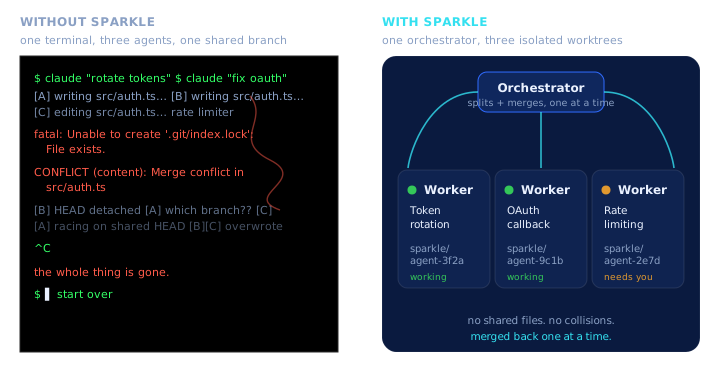
This is not a hypothetical. Try to run a few agents in one terminal against the same
project and you get the picture on the left: they race on the same branch, stomp the
same files, and git starts throwing index.lock and merge conflicts until you give
up and start over. Sparkle's orchestrator gives you the picture on the right instead.
So here's the good news that lets you exhale: you never have to learn to love the terminal to do this. That black-text window was never built for the way you're going to work. Sparkle is a modern app built for you instead. It shows you your projects, what each helper is doing right now, and exactly what changed, all visually, with buttons and even your voice ("Hey Sparkle..."). You stay in plain English, you stay in charge, and Sparkle keeps the whole build legible while you do the part you're actually good at: deciding what should exist.
You can muddle a single agent through a terminal. You cannot run a fleet through one, and the fleet is the entire point. Sparkle is built for it: parallel agents each working in isolation, a visual diff of every change before you keep it, and a risk-tiered approval gate so nothing dangerous slips through while you're moving at speed. This is the cockpit for the new discipline. The terminal was a single seat; you've outgrown it.
Sparkle runs the real Claude Code and wraps it in the control surface a fleet actually needs: every agent gets its own worktree and branch, so N agents run in parallel with zero cross-contamination; a risk-tiered approval gate stops anything destructive; highlight-any-line terminal actions, voice, and screenshot input when you want them. Your code stays on your machine, in real git, with real commits. The terminal is still there, one click away, when you want it. Sparkle just stops forcing a 1980s interface to do a 2025 job. The build runs on your Claude Code Max subscription (Pro, Max 5x, or Max 20x: more included usage and more parallel agents as you go up).